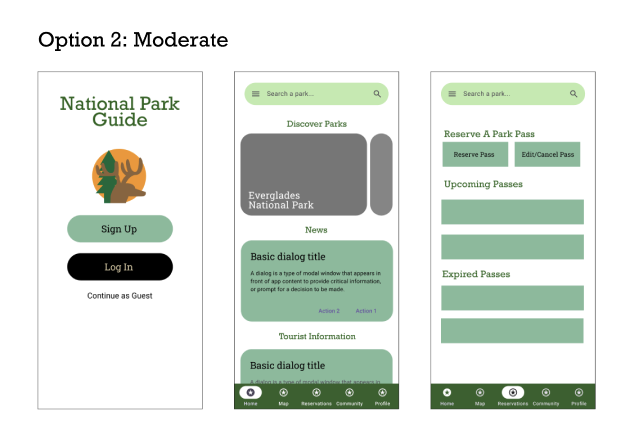
National Park Guide
A mobile guide that brings park planning, safety information, maps, and reservations into one clearer experience.
- UX research
- Interaction design
- Usability testing
Human-centered · AI-curious
I'm Nicolas Lepe, a junior UX/UI designer creating thoughtful digital experiences where emerging technology meets everyday human needs.
Selected work
Case studies that show how I think, make, test, and refine.
A mobile guide that brings park planning, safety information, maps, and reservations into one clearer experience.
A cross-platform shopping concept that helps people find sustainable fashion with clearer filters, favorites, and checkout flows.
About / Nicolas
I'm studying Digital Media—Web & Interactive Media—at the University of Central Florida, where I found my focus at the intersection of technology and creativity.
UX/UI design gives me a way to turn curiosity into meaningful interactions. Outside of interfaces, I draw inspiration from digital media, music, and the many ways people express themselves.
My design process
I use Design Thinking to move from research to a user-centered solution. The process is iterative, so I return to earlier stages whenever research or testing reveals something new.
Understand
I start by learning how people behave, what they need, and where friction appears. I also study the business and competitive context so the problem is grounded in reality.
Focus
I organize the research, identify recurring patterns, and decide which user need should guide the work. This turns a broad challenge into a focused problem statement.
Explore
I explore many possible solutions before committing to one. Brainstorming, sketching, and critique help me compare ideas and find the directions with the most value.
Make
I turn the strongest ideas into something people can experience—from low-fidelity wireframes to polished interactive screens. This exposes gaps before development begins.
Learn
I place the prototype in front of users, observe what works, and look for moments of confusion. The findings guide another round of improvements and, when needed, a return to an earlier stage.
Research, make, test, and repeat as the problem becomes clearer.
Looking forward
I'm exploring how intelligent tools can make products more helpful, adaptive, and expressive while keeping people in control.
